The Praxi context foundation
All three draw from one governed context foundation
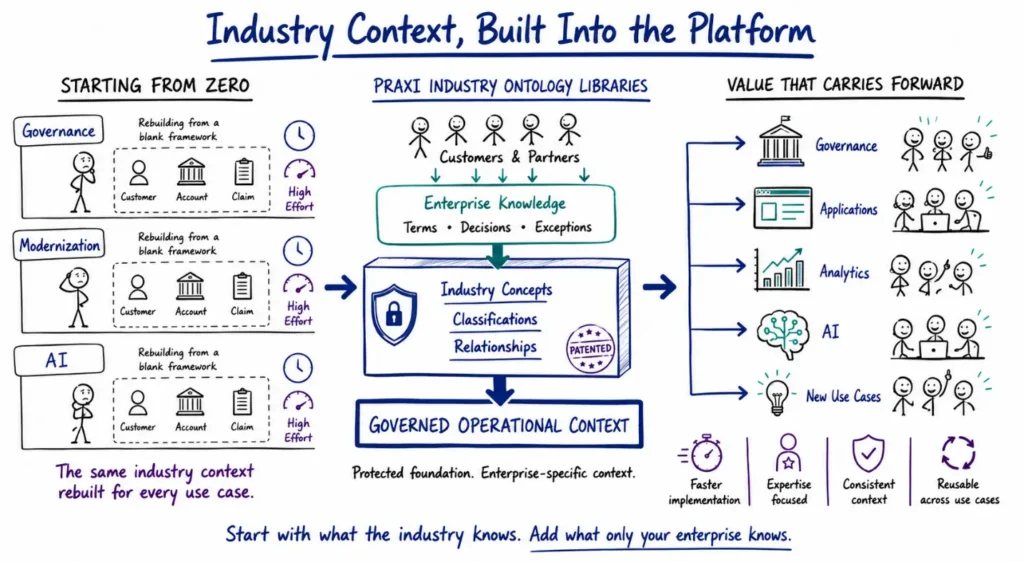


The Praxi context foundation
All three draw from one governed context foundation
Deployed inside federal, defense, and regulated enterprise programs

Department of Veterans Affairs

Department of Homeland Security

Defense Health Agency

60th Medical Group, Travis AFB

Department of Energy
Department of Veterans Affairs
Department of Homeland Security
Defense Health Agency
60th Medical Group, Travis AFB
Department of Energy
THE CATEGORY
A utility is the layer everything else depends on and nobody has to think about. Water, power, network. Praxi does that job for meaning: one governed foundation of context that sits beneath the enterprise stack and supplies it. That foundation is built from metadata, approved by the people accountable for it, and maintained as the enterprise changes. It is infrastructure, so it does not need to be rebuilt for the next application, the next tool, or the next model.
Applications
AI
Analytics
Governance
All four draw from one governed context foundation
The problem
Enterprise data was always fragmented. What changed is the pace. New systems, acquisitions, and purchased datasets arrive faster than any governance function can keep them accurate, current, and complete. So the enterprise builds on a foundation nobody can vouch for. Two systems disagree and both look authoritative. In regulated industries under more scrutiny every year, that is not a reporting inconvenience. It is exposure.
Meaning is not agreed
Every system carries its own name for the same business object, and nothing reconciles them. Each report restates the definition, so every number is arguable.
Context goes stale on delivery
A semantic model filled in by hand is out of date the day it is finished. Without automation and pipes to keep it current, the work has to be done again.
Controls have no evidence
olicy is asserted in documents rather than in the data layer. When an auditor asks who approved this and why, the answer is reconstructed by hand.
Why it compounds
Every project that starts by re-deriving what the data means pays for the same context twice, and leaves nothing behind for the project after it.
The answer
Praxi was built for the enterprises that cannot move their data, cannot guess at a definition, and cannot show up to an audit without evidence. Three things about how it works are ours alone.
Claim 01
Ships pre-trained regulated-industry ontologies
Insurance, financial services, healthcare, and defense arrive with a populated model. Customers start ahead of an empty glossary rather than filling in a blank coloring book.
Claim 02
Operates entirely on metadata, without custody of your data
Praxi works from what systems say about their data, never the records themselves. Nothing is read at the row level, copied, or moved, which is what makes the security review short.
Claim 03
Deployable into accredited federal and sovereign environments
Sovereign, air-gapped, on-premises, hybrid, and cloud. Deployment stays under customer control, and it is already running inside federal and defense programs.
Together, no other vendor makes all three claims
Reusable context
The value of a context foundation is not in the first project. It is in every project after it, drawing from the same well.
01
Built once
Definitions, sensitivity classes, and permitted use are established one time, against pre-trained industry ontologies, and approved by the steward who owns them.
02
Maintained continuously
Automated curation detects change across sources and routes it for review, so the foundation stays accurate as systems are added, corrected, retired, or acquired.
03
Reused everywhere
The same approved context is served to applications, analytics, governance tooling, and AI through open interfaces, so everything downstream reads one meaning.
Differentiation
The tooling most enterprises already own does useful work. It stops one step short of the question a steward is actually asked.
Where other platforms stop
Inventory what exists
A catalog lists the assets. It does not decide which one is authoritative.
Trace where it moved
Lineage follows movement. Movement is not meaning.
Assert policy in documents
A catalog lists the assets. It does not decide which one is authoritative.
Where Praxi begins
Context goes stale on delivery
A semantic model filled in by hand is out of date the day it is finished. Without automation and pipes to keep it current, the work has to be done again.
Context goes stale on delivery
A semantic model filled in by hand is out of date the day it is finished. Without automation and pipes to keep it current, the work has to be done again.
Context goes stale on delivery
A semantic model filled in by hand is out of date the day it is finished. Without automation and pipes to keep it current, the work has to be done again.
As easy as baking a cake,,,
The platform
Applications are replaced, data moves, and models change. When context stays trapped inside each implementation, every transition forces teams to reconstruct it from scratch.
Praxi maintains that operational context as a durable platform layer beneath applications, analytics, governance, and AI. Technology will keep changing. The context that explains how your enterprise operates doesn’t have to change with it.
Organizations can modernize the stack while carrying forward the business knowledge already established, so each new technology inherits it instead of starting over.
01
Praxi Discovery
What information exists across the approved enterprise environment, including what was added, corrected, or bought without anyone announcing it.
02
Industry Ontology Libraries
What that distributed information represents, resolved against pre-trained ontologies for your industry rather than a glossary you start empty.
03
Curation-as-a-Service
How that context stays accurate and useful. Automation detects drift, a named steward approves the change, and the record is immutable.
04
Praxi Integrator
How the enterprise puts context to work. Approved meaning is served through GraphQL, APIs, and SQL into the environment you already run.
Governance by Design applies across all four stages
Metadata in, governed context out
Enterprise AI
General AI tools start at the conversation and assume the data handed to them is already right. When the answer is wrong, they burn tokens working backwards. Praxi starts earlier, so the conversation begins on a foundation already known to be current.

With Praxi
General AI tools
Fewer iterations, lower token spend
The model enters the conversation already confident in the data, so it is not paid to rediscover it.
Model-agnostic by design
Switch models mid-conversation. Use a light open model for routine work and a heavier one for projections.
Search and chat in one place
Refine the query and add sources inside the interface, instead of leaving to go find and clean data elsewhere.
Industries
Each of these industries arrives with a pre-trained ontology library, so the first program begins ahead rather than at zero.
Insurance
Policy, claim, party, and exposure resolved across policy admin, claims, and billing.
Pre-trained library
Financial Services
Counterparty, product, and position defined once for risk, reporting, and supervision.
Pre-trained library
Healthcare
Patient, encounter, and workforce context aligned across clinical and administrative systems.
Pre-trained library
Defense & Federal
Mission, personnel, and readiness context inside accredited and air-gapped environments.
Pre-trained library
One foundation across the enterprise, not one per team
Enterprise AI
Praxi is metadata-first because that is a security posture, not a technical preference. There is no copy of your data to protect, no new silo to accredit, and no movement request to wait on.
Metadata-first architecture
Works from what systems say about their data.
No data custody
Nothing read at the row level, copied, or moved.
Authority at the point of use
Permitted use travels with the definition.
Traceability without a new silo
Evidence is produced as the work happens.
Sovereign and air-gapped
On-premises, hybrid, and cloud
Deployment under customer control
How programs grow
Nobody governs the whole estate first. A program begins on one bounded, high-value problem, and the context it establishes is what makes the next domain cheaper.
01
Focus
One bounded problem where the cost of fragmented context is already visible.
02
Establish
Approved context for that domain, with the stewards and the evidence trail in place.
03
Activate
That context goes to work in the applications, analytics, and models already in flight.
04
Expand
Adjacent domains reuse the foundation instead of rebuilding it, so each program costs less than the one before.
Each assessment compounds the one before it
Proof
Department of Veterans Affairs
Department of Homeland Security
Defense Health
Agency
Federal and defense deployments in accredited environments
90%
Less manual data preparation at a mid-sized insurer.
3x
Analytics adoption in the same program.
4
U.S. patents behind the metadata-first approach.
60th Medical Group, Travis AFB
Workforce and readiness context established against DMHRSi without moving records.
“Praxi is the key to unlocking a company’s data resources. It turns an information graveyard into a fertile field of discovery.”
Eric Kavanagh
CEO, The Bloor Group
The missing piece
Start with one bounded domain, in your own systems, on metadata alone. You keep the evidence either way.
Metadata only · steward-approved · audit-defensible